Northern Territory
Here my journey through Australia continues. I started in Tasmania, popped into Victoria, then worked my way up through South Australia and into the Northern Territory on this great Australian Adventure. I was travelling with my partner who I met while living and working in Melbourne. We converted a Holden Jackeroo into a camper car and set off to explore Australia.
The Northern Territory was the last but certainly not the least. It has so much to offer and since the climate is more tropical than other states, there is a huge difference in the landscape and the scenery. Culture, gorges, wetlands and amazing natural formations...what's not to like.
We entered the Northern Territory on 7th May 2017.
Uluru
‘Welcome to Northern Territory’. It was such a little sign. There had been a stopping area a couple of kms before with information about South Australia and Northern Territory, the border itself seemed a bit insignificant though. There were no fruit and vegetable restrictions going in, it seems to be products coming out of the Northern Territory that is not allowed.
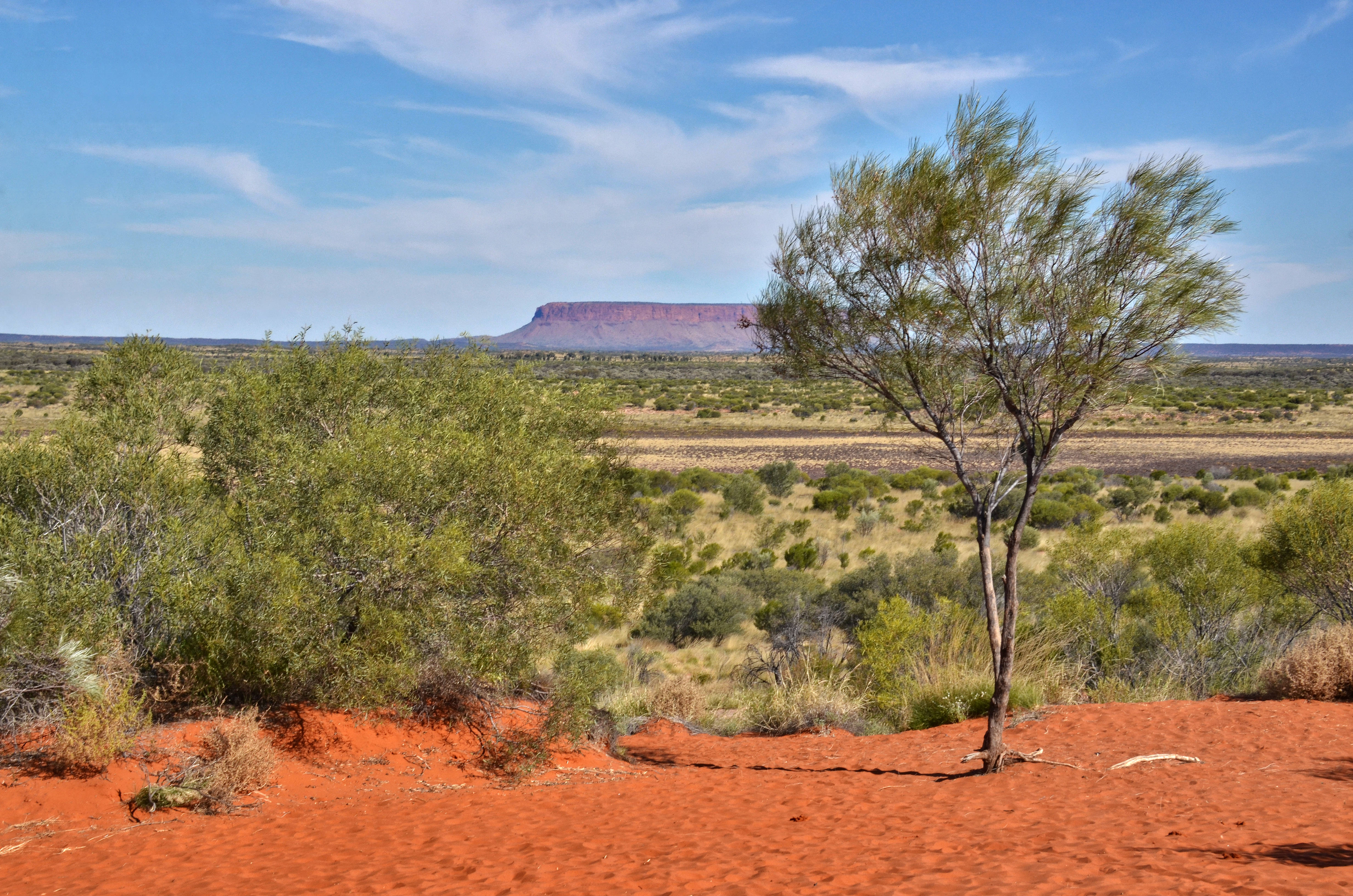
There were dome hills ahead of us and it was more bushy, even a bit grassy, which is interesting, since it is called the red centre. We thought we saw Uluru (Ayers Rock) from 100km away but later found out that we actually saw Mt Conner, otherwise known as, Fooluru, quite appropriately. It certainly fooled us. The rock looked purply red, really nice. There was a lookout a bit further along. To one side, Mt Conner, to the other, a salt lake. The toilet at the lookout smelled so bad. The worst smell from a drop toilet so far. Normally they're not as bad as you would probably imagine. A bit later we passed a little pond with dead trees in again. That is becoming a common occurrence too. It was surprising to see water here though. The road signs are quite different here to in South Australia, I can tell we are in a different state. As we approached Uluru, there were proper trees all around us. Then, a large group of cows, all clustered around the road. We were meant to be sleeping at Curtain Springs, about 90km from Uluru but decided to go to the Yulara resort just 20mins from Uluru.
Yulara is a huge big, fancy resort with multiple hotels, restaurants, souvenir shops, a bank, post office, and supermarket. Oh, and petrol station, priced at $193!! The most expensive yet. Well, everything there was expensive, including the campsite at $39 per night. Yulara was a little village really with a ‘town centre’, with a water feature and tables. There seemed to be lots going on and there were some free activities. Essentially, things to amuse families who stay there for a week. We quickly dashed down to the National Park, where we bought our three day pass for $25 each, then went to the sunset viewing area for Uluru. The sunset was behind us, so really, we were watching the colour of Uluru change. For me, it was best before sunset, when the low sun set it ablaze with light.
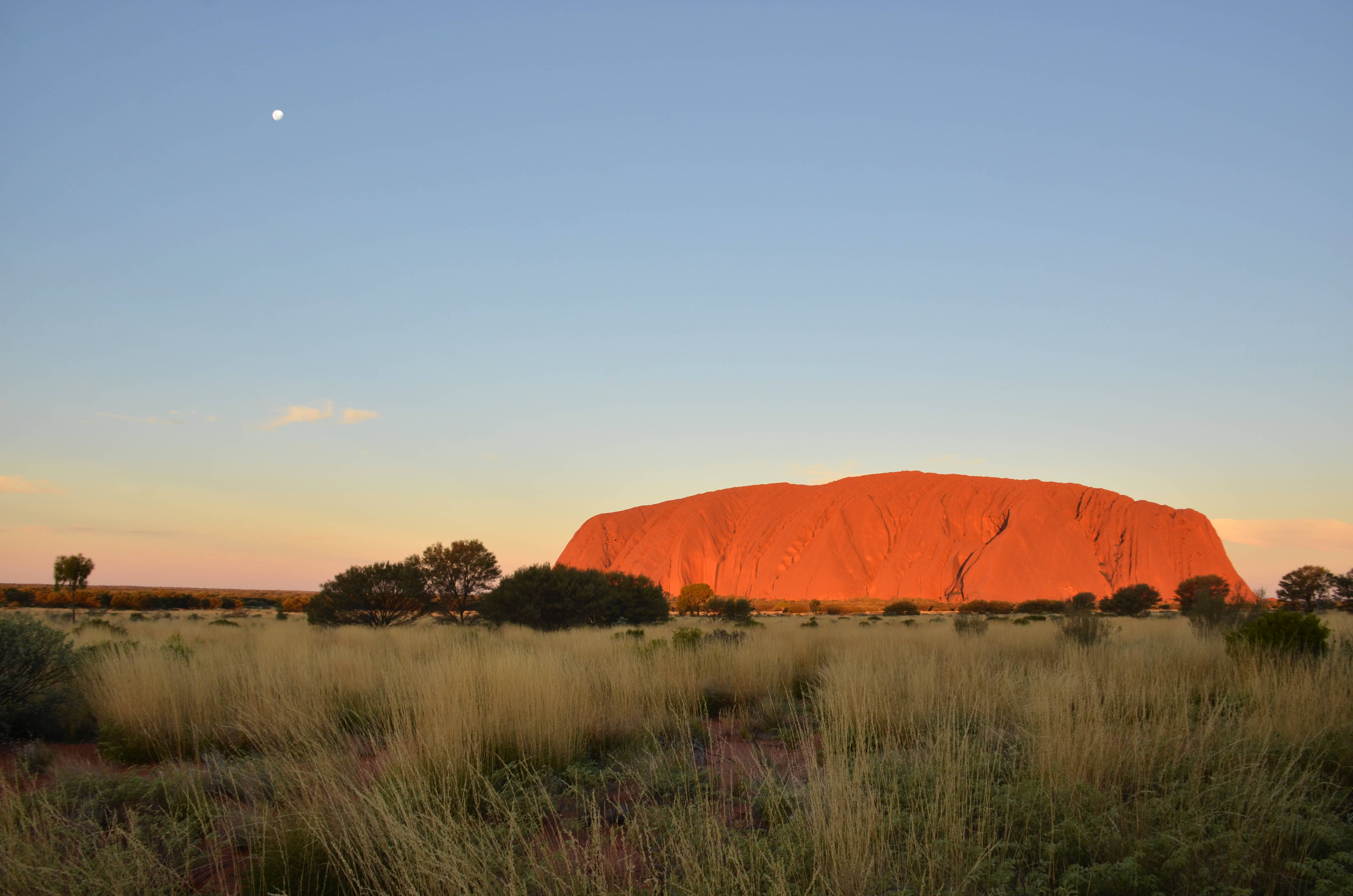
Uluru and Fooluru are actually completely different shapes, Uluru is a bit domed on top and it’s sides are not completely straight. It is not smooth but has lots of holes and crevices. It is orange/red, like the ground. We found out the following day that the rock is actually grey/blue but it has essentially gone rusty due to it’s high iron content.
We were up at 5:15am to watch the sunrise over Uluru. The stars were still out and I saw another shooting star! So special. There were some rabbits at the campsite. I’ve not seen wild rabbits since Denham, WA. The park opened at 6am and we were there at 6:04. We went to the other side of Uluru, so again, had the sun rising behind. The sunrise itself was great. The sky changed colour so much, there were some wisps of cloud, which went from being on fire, to glowing white. That was all too low in the sky to have been able to see it behind Uluru had we been on the other side. In terms of Uluru itself, as the sun came up it turned from being a dark, shadowy red, to a bright orange. There were so many people there for the sunrise. It was freezing, I couldn’t feel my fingers! Yes, it does get cold in the centre of Australia. We spent an hour or more at the cultural centre waiting for the Mala guided walk. The cultural centre was really interesting. There was so much to read about aboriginals and the significance of Uluru to them, the native animals and the joint ownership of the National Park. There were also a couple of videos playing. It's definitely worth a visit.
The guided walk was nice. We only went as far as Kantju gorge, about 2kms, but it took 2 hours as the guide was giving us lots of information on bush tucker, aboriginal history and geology. Since the sediment is in vertical layers, it is thought that Uluru was tipped on its side. Quite impressive considering that it is like an iceberg with another 6km underground. The gorge was lovely. It was shady and so quiet. There was water there. The rock was black with mildew where the water runs down when it rains. The guide said it rained a lot over Christmas and he showed us a photo of water pouring down the side of Uluru in a powerful waterfall. There were a couple of craters in the rock, creating a series of pools above the gorge. So when each of those filled, the water just poured down. There were a few caves too, which had various uses in the past, some for cooking, others for teaching with things drawn on the walls with ash. From a distance, Uluru looked sandy, like a big dune but up close we could see that it was solid rock, with lots of craters and ribs. Uluru is 3.6km long and 348m tall, which is taller than the Eiffel Tower. By 11/12 o’clock it was pretty warm in the sun. A bit windy though, which kept it pleasant. As well as the base walk track, there is a road all around Uluru, which we drove along to get to the opposite side, where we did the Kuniya walk to Mutitjulu waterhole. It was a leisurely 45 minute walk ending in a beautiful waterhole area. There was a small cave too, where aboriginal people used to camp when visiting Uluru. A great spot with water, food, shade and shelter. There was a trickle of a waterfall filtering into the waterhole, which was surprising since there had been no rain. That is the only permanent waterhole around Uluru. The flies were out in force and we made use of our fly nets. They were still buzzing around our heads but at least they couldn’t get to our eyes and noses. Well worth it. Yes, we looked ridiculous but who cares, so did everyone else.
We headed back to the cultural centre as there was still stuff to see. There were artwork and souvenir shops there too. There was a lot to look at. It was very expensive of course.
It was still possible to climb Uluru when the conditions were right when we were there in 2017. The aboriginal community do not like the climbing of Uluru since it is sacred for them. In the last 70 years, 35 people have died climbing Uluru. The Government has agreed that by 2020, if less than 20% of visitors climb, it will be permanently closed. I don’t know why they didn’t just close it. Yuluru was created to give tourists other things to do and there is certainly plenty on offer. There is a chain up Uluru to help people climb. We saw it from the bottom and it looks terrifying. Apparently that is the only possible way up but I do not know how they deemed that a possible way up. It was steep, almost vertical. I do not know why people would even want to climb that and there is nothing really to see from the top, since it is surrounded by flat land. It was actually quite green and bushy, which is apparently unusual. I think we were told that it is currently the greenest it has been in 50 years. There was tall grass everywhere, which was introduced after a fire burnt the ground. It seemed so odd, I was not expecting that at all. I also was not expecting it to be so built up and I did not like that. All the roads were sealed and there was the big resort. It did not feel like we were in the middle of the country at all. It did not feel like a special place that we had made the effort to get to. It felt like everyone was there and due to the spas, pools and fancy bars and restaurants, it did not feel like we were in the outback. For me, it lost some of its charm because of that. I was expecting something very natural and remote.
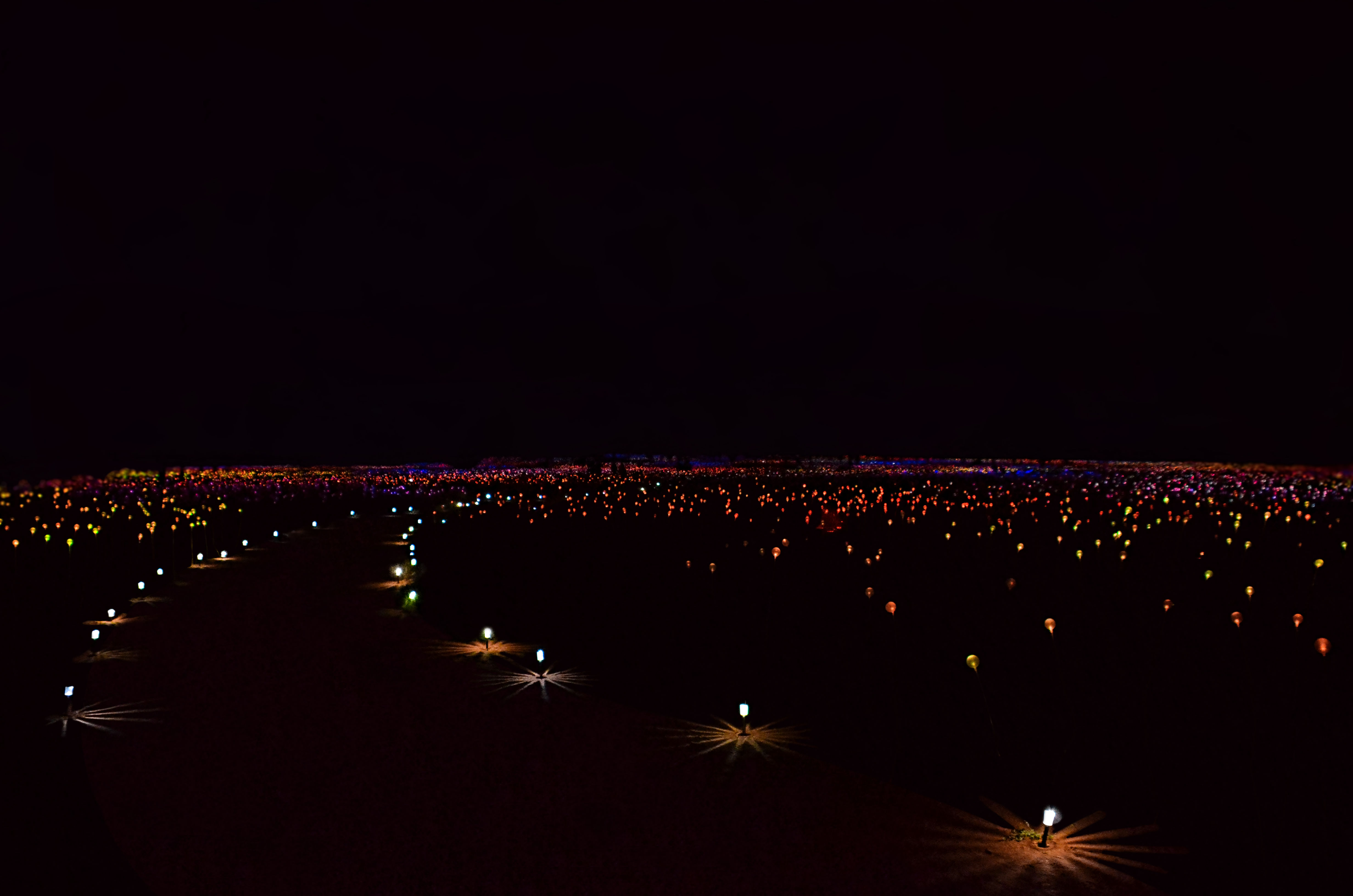
That night we went to the ‘field of light’ exhibition. It was an outdoor, solar powered, fibre optic, art display. Light stems were connected by 380km of optical fibre. The balls on the top change from red to blue to purple to white. They were everywhere. A pathway, also lit by solar, weaved amongst these light sticks. Looking up, we had light dots above us too, thanks to the stars. It was special. Something that we will not have the chance to do again. It was pretty. It was good that it used solar. It was off to the side of Yulara so not interfering with the National Park at all. Wildlife would certainly get a shock if they came across it. It was a nice experience. They picked us up and dropped us off at the campsite and we had about an hour walking around the lightfield. It cost $39 each.
When we arrived at the campsite, a local cleaner told me to watch out for snakes! I only saw a gecko, a mouse and some birds though. Things like that really put me on edge for a day or two but then I would forget about it and not worry about snakes at all. I had been a bit put off going to Australia because of snakes, spiders, sharks and crocodiles but I didn't have any experience with any of them during my year in Australia. I did hear of sharks around Melbourne while I was there and therefore did not go in the sea but I did swim in Western Australia and Queensland.
Kata Tjuta
We were up at 5:15am again. This time to watch the sunrise over Kata Tjuta (mt Olga). Kata Tjuta is about 50km from Uluru, again on a sealed road. It is made up of 36 domes, the highest of which is 546km, almost 200m taller than Uluru. The dune sunrise area was perfect. It was located in such a way that the sunrise over Kata Tjuta was similar to that of Uluru the day before, with the sun coming up behind us, lighting up the rock as it came. The difference was that behind us, as well as the sun, was Uluru. I finally got what I wanted. The sun behind Uluru lighting up the sky with the silhouette of Uluru in front.
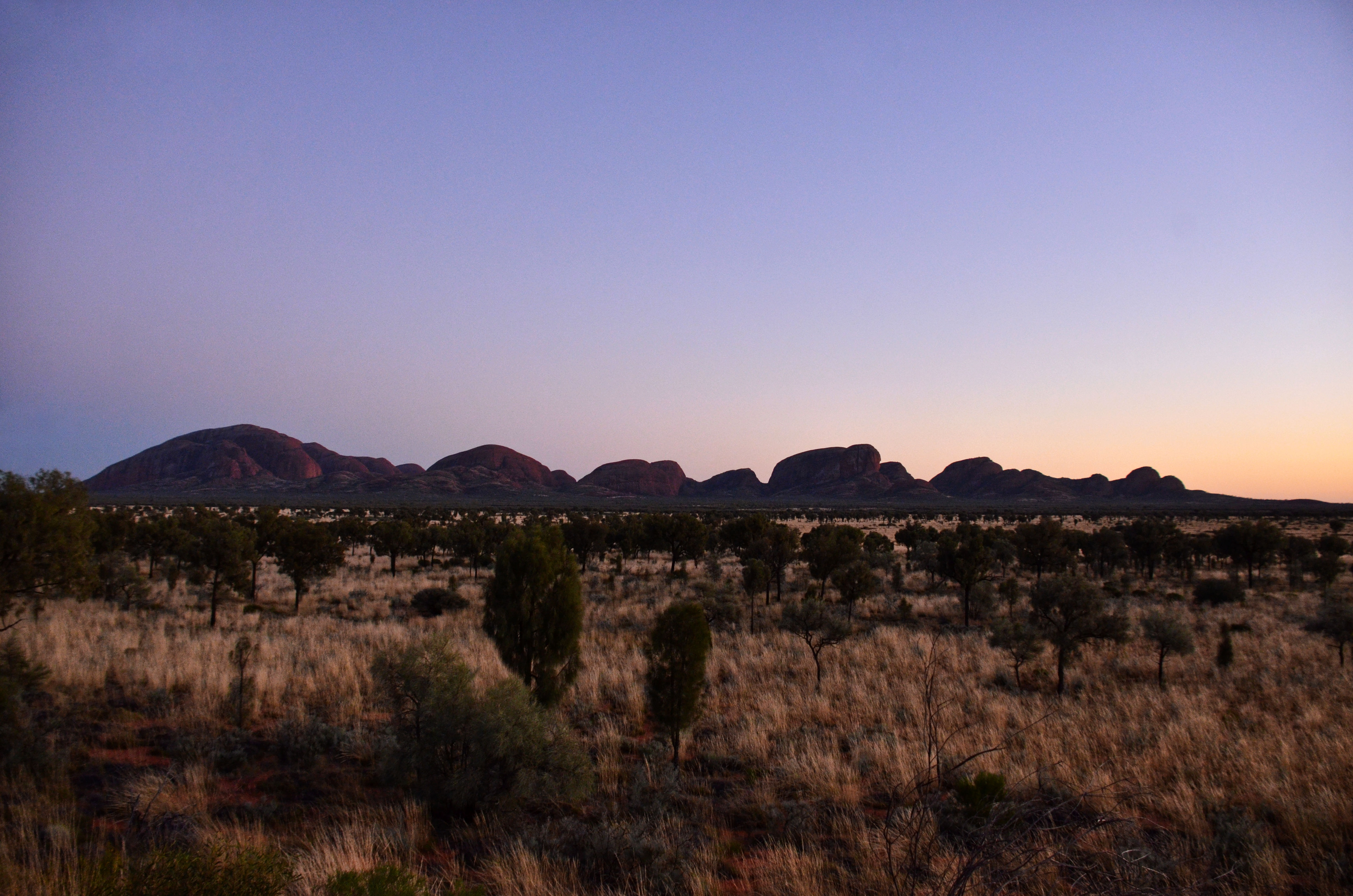
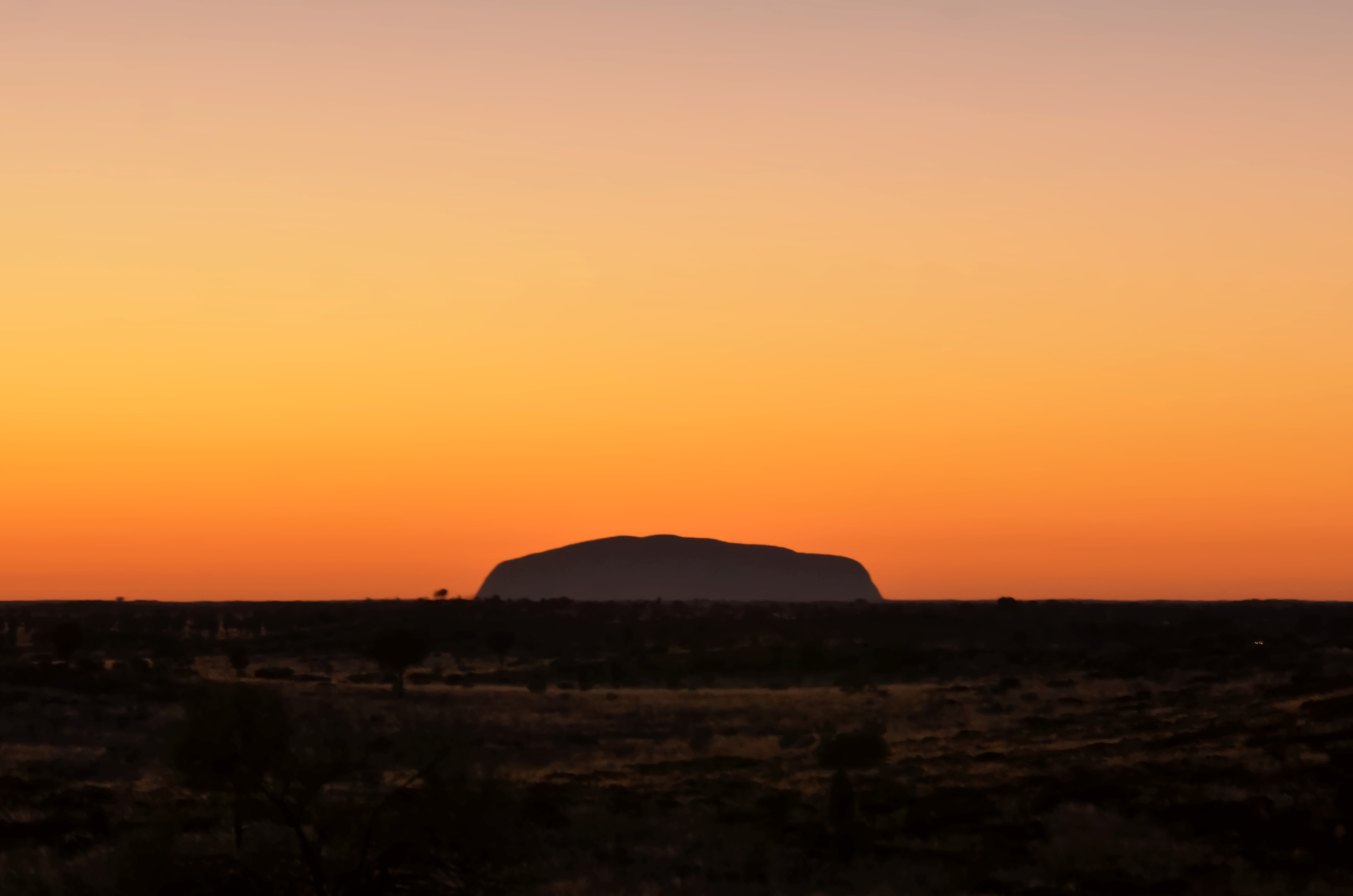
There were fewer people there and whilst it was cold, we had dressed more appropriately, which made the whole experience more enjoyable. It was great. We headed to the valley of the winds.
Unlike Uluru, it is not possible to drive around Kata Tjuta. Therefore, we definitely did not see the full extent of it. We only did the Karu lookout walk, about 1hr, since we did not have a whole heap of time. The Karingana lookout would have given spectacular views of the domes I am sure but it was much further. We saw where people were walking and it seemed to be on the rock face of one of the domes, which does not seem very respectful to the aboriginal sacred site.
At the start of the walk we were alone but later there were lots of people. We saw a big grasshopper that I only saw because it moved. It was the same colour as the little rocks. The path was quite rocky and was a slow but constant incline. As we got higher it got more uneven. The view was out between two domes like looking across a valley. By this time it was sunny so the domes were glowing orange. On the way back down we saw a man coming up with a zimmer frame! I do not know how he was managing to get on with all the rocks. Good on him I suppose. We also did the Walpa gorge walk, which was also one hour. It was windy around Kata Tjuta so the walk up the gorge was really pleasant. There were areas of water and even some bush growing on the rock. There was a viewing platform at the end, looking out of the end of the gorge. It was lovely.
Kata Tjuta is a completely different texture to Uluru. It is rocks and stones all compressed together with sandstone, whereas Uluru is sandstone. The colours are mostly the same although Kata Tjuta is perhaps more marbled with burnt orange, red, brown and black. Again, where there have been waterfalls, the rock surface is black with mildew. We could only see a small section of Kata Tjuta though. From a distance, Uluru looked smooth, but up close it was quite mottled and flaky, like old paint peeling off a wall.
That night we slept at Curtain Springs, a farm with some accommodation and petrol. That seems quite common here. It is a good business for them, there is nowhere else so people will stop. It was free, just $3 for a shower. It was a nice spot and we were 90km further on for the next day. There were loads of what we thought were baby mosquitoes. There are mosquito borne diseases over here, which there is no prevention or cure for. I have not seen any signs about it since being in the Northern Territory though. There were heaps of signs with methods to avoid mosquitoes in Tasmania and South Australia. At 5:30pm it was still hot but it went cold when it went dark. In the morning it was so cold. I couldn’t feel my fingers!
Kings Creek
We stopped at Kings Creek to get petrol but since it was 202.9pl, 10c more than Yulara, we decided to wait, thinking that the next one could not be any more expensive. We were wrong! 210.9pl! Ridiculous. We had to fill up...oops. The least it has been is 117.9pl. What a difference.
At Kings Canyon there was a 4hr rim walk, which would have been fabulous but we did not have time for that. It was the same as Kata Tjuta in that the tracks were closed at 11am on days of 36+ degrees celsius. We did the creek walk where we walked along the dry riverbed. That was only one hour. The colour of the cliffs was amazing, it was a mix between burnt orange, fire red and a bit of chocolate brown. In places we could clearly see all the individual layers of sediment layered up. They had made a proper path from the rocks on the riverbed, which was pretty cool. It was bone dry but the year before it had all flooded and a rock was washed down causing damage to a viewing platform, which is no longer there. We saw lots of ants and a couple of little lizards. The view at the end was a bit masked by trees but the walk was interesting.
Back on the road, the ground was so red. No wonder it is called the red centre. We keep coming across a strange thing. Lemon/melon type things all along the edge of the road. They are in clusters, there will be none and then 50 altogether, it is very odd. We have no idea what they are. They seem to be growing on vines along the road. I said lemons/melons because they vary in size and colour a bit. Strange. After leaving Kings Canyon, we were on to a big, wide dirt road. It was so red. We stopped at a lookout for the canyon range, which was great. A tornado crossed the road in front of us, a proper tornado! We could see the wind whirling round, that is definitely the biggest one we have seen, we had to stop and wait for it to pass. The road was in the process of being sealed, which will make a big difference. The section from Kings Canyon was terrible, it was so bumpy and we kept sliding. We met a French guy and Argentinian girl the next day, who also had a Jackeroo, and they had the same problem. It was on par with the start of the Coober Pedy road but this one was a lot longer. It was really rough. There were signs for camels along the road, we saw so much camel poo at the side of the road, it is easier for them to walk along the road I suppose, but sadly no glimpse of a camel. We seemed to be following the poo trail for ages, I do not know where they were hiding! The last couple of days there have been flies everywhere! We have been making use of our fly nets but they buzz around our heads. At least they cannot get to our eyes and noses.
We slept at Ntaria campground. Ntaria (Hermannsburg) seemed to be an aboriginal settlement but all the staff in the supermarket (who were the owners of the campground), were non-aboriginal. The campground and cabins for the supermarket staff were all fenced in with high, metal fences with barbed wire tops. All the aboriginal houses were individually fenced but with low fences. We discovered that the reason for all this fencing was wild dogs. We could hear dogs howling the whole time we were there. We saw three dogs at the side of the road when we first turned into Ntaria, they were small dogs, they looked like pit bulls. Definitely not dingoes. Apart from that, we didn’t see anything, no other wildlife either. We were the only ones at the campsite, which was actually quite nice and with the fence, I felt safe. The only thing we had was mosquitoes. Lots of mosquitoes. It was a small site and between the lit toilets and the lit bbq area we did not even need a torch. We only just made it in time for the site, the staff were just leaving work as we arrived.
MacDonnell Ranges
As we left Ntaria in the morning, we saw a beheaded cow at the side of the road. Not a very pleasant way to start the day. The plan was to go to Finke Gorge but the road was only suitable for high clearance 4x4s, so we skipped that and continued on to the MacDonnell Ranges. The ground was red but quite densely bushy and not flat anymore.
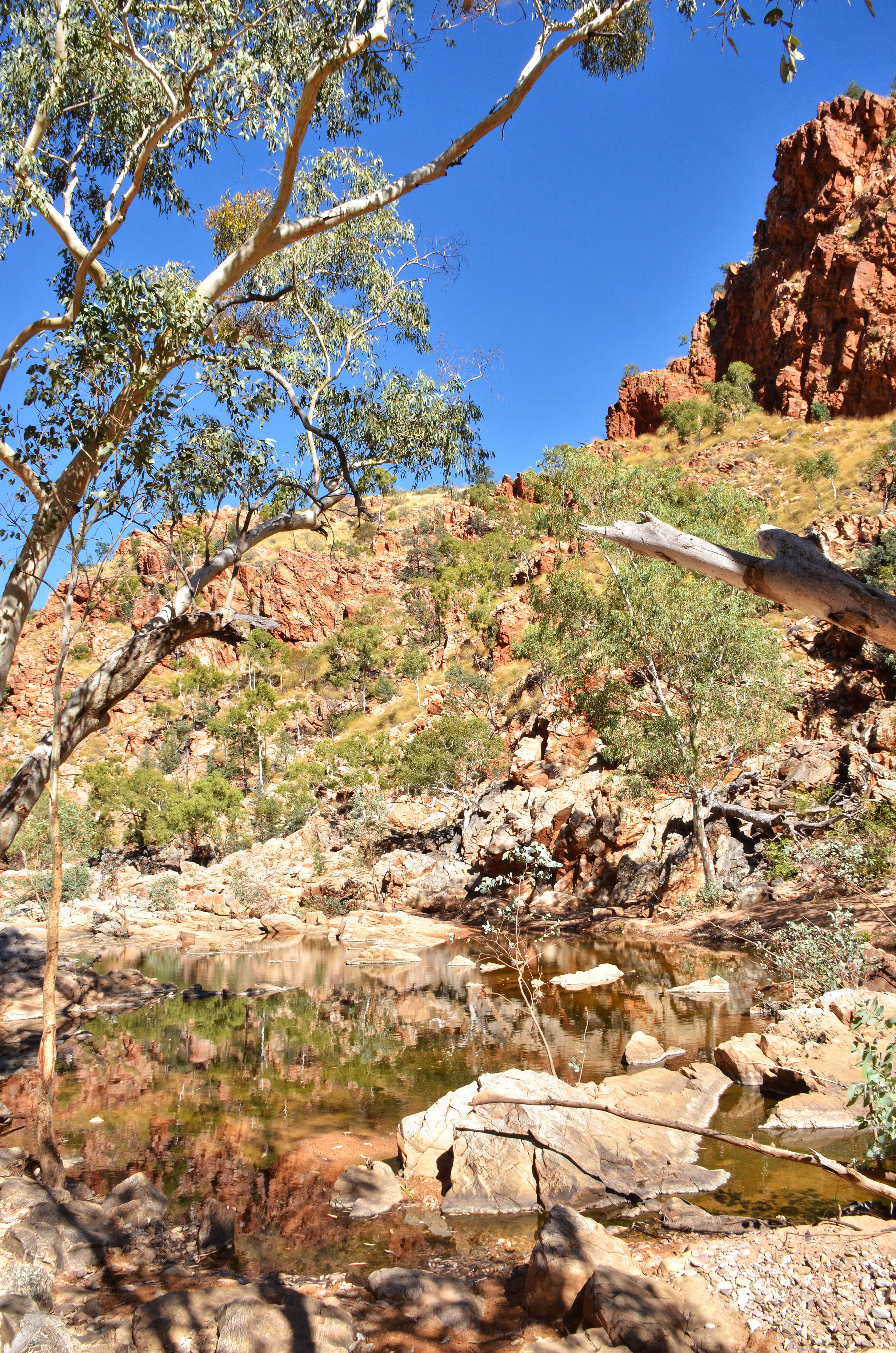
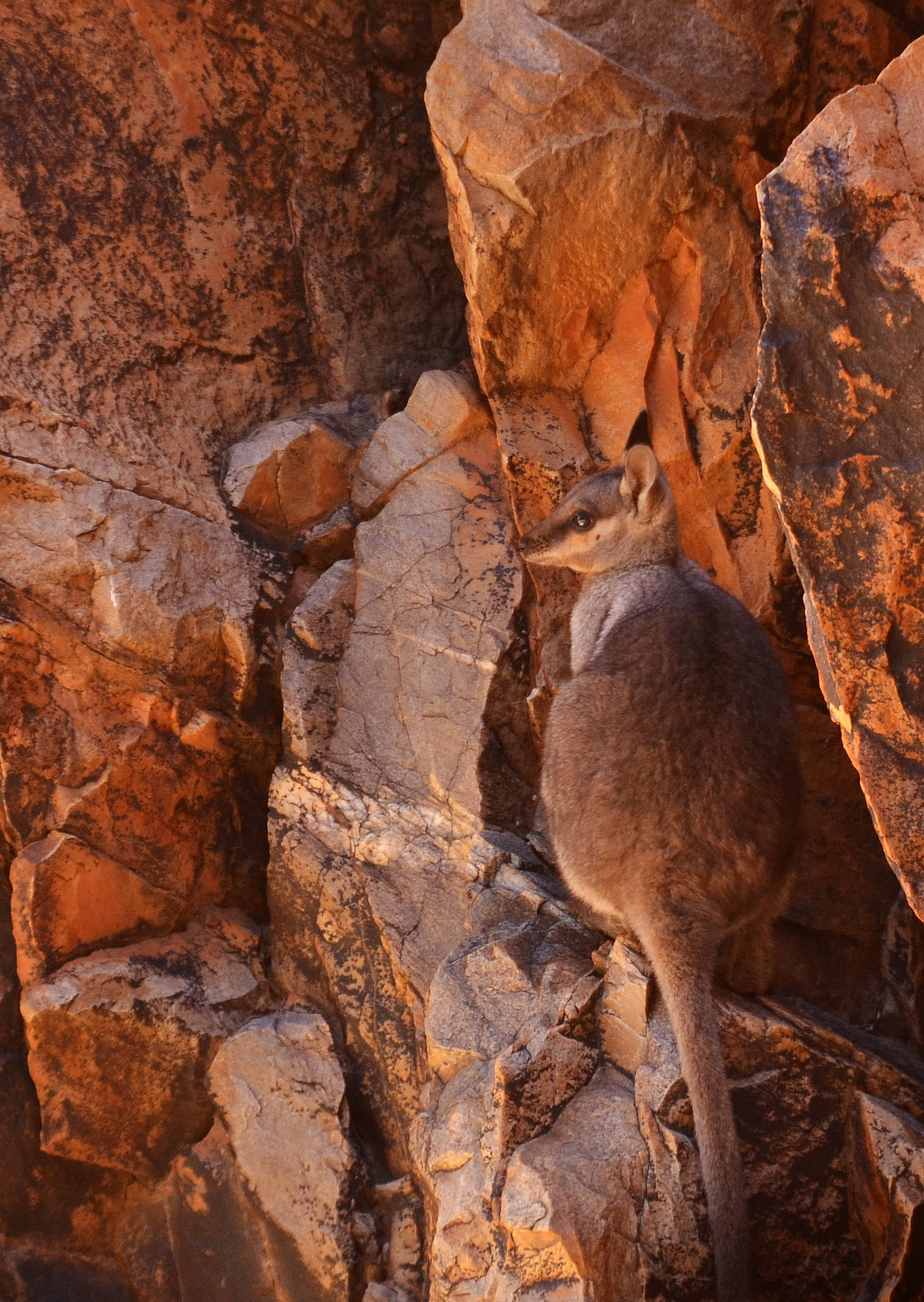
Redbank Gorge, our first stop in the MacDonnell Ranges, was pretty amazing. We walked down the riverbed, along the rocks. There were rock pools with little fish in...so many fish. There were at least four generations of the same type of fish, all at various stages of growth. There were some big pools but one tiny pool that will surely dry up if there is no rain...the poor little fish. There were so many bees too, in the trees and drinking at the pools. At the end of the creek bed was the gorge, we could just see into it over a large pool of water. The sheer, orange/red cliffs, as the gorge deepened, were pretty spectacular. It was a bit of a climb over the rocks to get to the entrance but it was well worth it. We couldn’t go any further because of the water. We saw a rock wallaby, only because it moved though, it blended so well with the rocks. I don’t know how it jumps on those rocks with it’s big, flat feet.
This is probably the hottest it has been, by 11am it was already hot, that’s what comes with going North. While driving, we were surrounded by hills and rocks. One range was kind of corrugated, like an upside down flan crust. We were meant to be staying at Glen Helen but since we skipped Finke Gorge, we continued on after a quick visit. Glen Helen was just a pub with a campsite behind but there was a short gorge walk along the riverbed to the gorge opening. It was lovely, and again ended at a pool of water by the gorge opening.
Next up was the Ormiston Gorge. We started by walking down to the waterhole, only 5 mins, where there were people swimming and sunbathing on a little beach area. It was a really pleasant spot. Then, we climbed up to the top and looked down into the gorge. That was lovely, we could see further into the gorge than from the waterhole. The path was a mixture between steps and slopes but it wasn’t that strenuous. Both walks, including photo and toilet stops, took 1 hour.
Our last stop in the MacDonnell Ranges was Ellery Creek Big Hole. It was just lovely. Only 2km off the main road and then a short, 2 min, walk took us to the end of the gorge. It was stunning. The gorge cliffs were reflected in the big, calm pool. There were so many birds around and their birdsong was all we could hear. We were the only ones there. It was really lovely. A bird went past flying like a swimmer! It flapped its wings a couple of times and then tucked its wings in close to its body and glided...then repeated. I’ve never seen a bird do that, it was so cool. I don't know what kind of bird it was.